
Overview
At Techtimize, we help businesses harness the true power of Artificial Intelligence to transform data into decisions and ideas into intelligent solutions. From predictive analytics to generative AI, our services enable enterprises, startups, and growing ventures to innovate faster, reduce costs, and deliver personalized experiences. We don't just build AI tools—we build future-ready ecosystems that drive measurable business growth.

What We Are Good At
Benefits of Our Artificial Intelligence Services
Our AI expertise goes beyond technology—it's about solving real business problems. We ensure every solution aligns with your business goals, industry standards, and customer needs.
Our AI Development Process
We follow a structured approach to AI development that ensures successful implementation and maximum ROI. Our process begins with understanding your business objectives and data landscape, followed by careful planning, model development, and seamless integration.

Industries We Focus On

Expand Your Business With Techtimize!
Do you have a business and want to leverage AI to drive innovation and growth? Then we're ready to help!
Blogs
Web App Development
How to Build a Great Website - The Complete Expert Guide
In today’s digital landscape, a website is often the first interaction a customer has with your brand. Whether you are launching a personal blog, a small business portfolio, or a large corporate platform, the quality of your online presence defines your credibility. Many beginners often ask how to build a great website that not only looks professional but also performs well on search engines. The good news is that creating a high-quality site is more accessible than ever, provided you follow the right structural and design principles.This guide will walk you through the entire process, from initial planning to technical execution. We will explore website design suggestions, technical requirements, and content strategies that ensure your site engages visitors and converts them into loyal users. By the end of this article, you will understand exactly what goes into a successful digital platform and how to navigate the complexities of web design and development.Starting With a Solid Website StructureBefore you write a single line of code or choose a color palette, you must establish a clear foundation. Building a website without a plan is like building a house without blueprints; it may stand for a while, but it will eventually encounter structural issues. The first step in learning how to create a good website is defining the site architecture.A well-planned structure involves creating a sitemap, which is essentially a flowchart of your website’s pages. This helps you visualize the hierarchy of information. For a basic website, this might simply include a Home page, an About page, a Services section, and a Contact page. However, for more complex cool software websites or e-commerce platforms, the structure needs to accommodate product categories, user accounts, and support portals.Defining this structure early ensures that your web design layout pricing and development efforts are focused on necessary pages rather than superfluous content. It also aids search engine crawlers in understanding the relationship between different pages, which is a critical component of SEO strategy.Preparing High-Quality ContentOnce your structure is in place, the next phase is content preparation. Many people make the mistake of designing the visual layout first and trying to squeeze text into it later. However, content is king. The text, images, and videos on your site are the primary reasons visitors arrive, and they should dictate the design, not the other way around.Effective content preparation involves gathering high-resolution images, writing compelling copy, and organizing your assets. If you are wondering how to make a website look better on sites like Google, the answer often lies in the quality of your content. Search engines prioritize content that is authoritative, relevant, and comprehensive.You should also consider the tone of your writing. Whether you want a professional corporate voice or a friendly, conversational tone, consistency is key. Writing your content beforehand allows you to spot gaps in your visitor’s journey through your website, ensuring that every page serves a specific purpose and answers user intent effectively.Mastering Website Design FundamentalsWebsite design is where functionality meets aesthetics. This is the stage where your brand comes to life visually. When discussing website design suggestions, industry experts always emphasize the balance between beauty and usability. A site that looks stunning but is difficult to navigate will ultimately fail to retain visitors.Visual Hierarchy and LayoutVisual hierarchy refers to the arrangement of elements in a way that implies importance. By using size, color, and contrast, you guide the visitor’s eye to the most critical information first. For example, your main headline should be larger than your subheadings, which in turn should be larger than the body text. This is a staple in web page design tips.How to design a page effectively involves using white space,or negative space,strategically. Cluttered pages overwhelm users. Simple web design concepts advocate for breathing room around text and images, which makes the content easier to digest. If you look at the best IT company website design examples, you will notice they often utilize clean lines and open spaces to convey sophistication and technological prowess.Color Theory and TypographyYour choice of colors and fonts plays a significant psychological role. Colors evoke emotions; blue often signifies trust and stability, while orange can create a sense of urgency or creativity. When deciding how to make web design choices, select a color palette that aligns with your brand identity and stick to it across all pages.Similarly, typography affects readability. Web page design for beginners often includes the advice to limit your font selection to two or three complementary typefaces. This ensures your simple website page looks cohesive rather than chaotic. Legibility should always be your priority over stylistic flair.The Visitor’s Journey Through Your WebsiteA truly great website guides the user seamlessly from their entry point to a desired action. This flow is known as the user journey or user experience (UX). Understanding how to create a great website requires empathy; you must anticipate what your visitor needs at every step.Navigation is the compass for this journey. Your menu should be intuitive, with clear labels that tell the user exactly what to expect. Avoid clever or abstract terms in your navigation bar; stick to standard conventions like "About Us," "Services," and "Contact." This is one of the most practical tips for making a website user-friendly.Furthermore, consider the placement of your Calls to Action (CTAs). Whether you want users to sign up for a newsletter, request a quote, or make a purchase, the path to that action should be frictionless. If a user has to search for a way to contact you, you have likely lost them. Step by step website design focuses on removing these barriers to ensure a smooth path to conversion.Selecting the Right Website TechnologyThe technology stack you choose acts as the engine of your website. For many, the question "how hard is it to build a website?" depends entirely on the tools selected. Today, you have a spectrum of options ranging from simple websites built on drag-and-drop builders to complex, custom-coded applications.CMS vs. Custom DevelopmentA Content Management System (CMS) like WordPress is a popular choice because it balances power with ease of use. It allows you to manage content without needing deep technical knowledge. For those asking how to make a good website without coding skills, a CMS is often the best answer.On the other hand, custom development is reserved for specific needs where off-the-shelf solutions fall short. While basic web design can be achieved cheaply, custom solutions will increase the average cost for website design significantly. However, they offer unparalleled control and performance optimization.Hosting and Domain StrategyYour domain name is your digital address, and your hosting is the land it sits on. Choose a domain that is easy to spell, memorable, and relevant to your brand. Secure, fast hosting is equally important; a slow server can destroy your user experience regardless of how beautiful your simple design website is.9 Essential Tips for Making a Website SuccessfulOnce you understand the structure and technology, you need to focus on optimization and refinement. Here are nine critical website design tips to elevate your site from good to great.1. Keep It SimpleMinimalism is not just a trend; it is a functional necessity. Simple web page design reduces cognitive load, allowing users to find what they need quickly. Basic website design does not mean boring; it means stripping away the non-essentials to highlight what matters. When you prioritize a simple looking website, you often improve conversion rates because there are fewer distractions.2. Ensure Your Website is Optimized for All DevicesWith more than half of global web traffic coming from mobile phones, mobile responsiveness is non-negotiable. How to make a website look better on sites across different screens involves using responsive design frameworks that adjust layout elements automatically. Whether a user is on a desktop, tablet, or smartphone, the experience should be fluid and functional.3. Content is KingWe touched on this earlier, but it bears repeating: content drives traffic. How to develop a good website relies on providing value. Your text should answer the user's questions and solve their problems. High-quality, original content is the single most important factor for ranking on Google.4. Optimize Site Load TimesSpeed is a critical ranking factor. A delay of just a few seconds can cause a significant drop in visitor retention. To make a great website, you must compress images, minify code, and leverage browser caching. Fast-loading sites are perceived as more professional and trustworthy.5. Improve Inclusivity & AccessibilityThe web should be accessible to everyone, including people with disabilities. Following Web Content Accessibility Guidelines (WCAG) ensures that your site can be used by people with visual or motor impairments. This includes using alt text for images, ensuring high color contrast, and enabling keyboard navigation. Website design advice increasingly focuses on inclusivity as a standard, not an option.6. Organize Your Site WellA logical hierarchy helps both users and search engines. Use breadcrumbs, clear headings, and internal linking to connect related content. If you are researching how to build a great website, you will find that "siloing" your content into distinct categories helps establish topical authority in your niche.7. Shorter Can Be BetterIn an age of short attention spans, brevity is a virtue. Long walls of text can be intimidating. Break up your content into shorter paragraphs and use concise sentences. This approach to web design tips ensures that your message is communicated clearly and quickly.8. Implement an SEO StrategyA beautiful site is useless if no one can find it. How to make a website successful involves keyword research, meta tag optimization, and link building. You need to integrate keywords like best IT company website design or website design and development naturally into your copy to signal relevance to search engines.9. Find Creative SupportSometimes, you cannot do it all alone. Whether it is hiring a graphic designer for your logo or a copywriter for your blog, professional help can elevate your project. If you are wondering how hard is it to make a website alone, the answer is that while possible, collaboration often yields superior results.Analyzing Website Costs - Budgeting for SuccessOne of the most common questions beginners have is regarding the financials: how much does it cost to design a website? The answer varies wildly based on your needs.For a basic web design using a template and a DIY builder, the costs are relatively low. You might pay a small monthly fee for the builder and hosting. This is ideal for personal blogs or simple websites.However, if you require a professional touch, the average price for web design increases. Hiring a freelancer might cost anywhere from a few hundred to a few thousand dollars. For a full-scale agency project, the web design price can range significantly higher. Factors influencing how much should web design cost include the complexity of features, the number of pages, and the level of custom graphic design required.It is important to view this as an investment. A cheap site that fails to convert customers is a waste of money, whereas a higher web designer cost that results in a high-performing sales platform pays for itself. Always ask for a detailed breakdown of web design layout pricing before committing to a provider.Why Techtimize is Your Go-To Specialist for Website DevelopmentBuilding a high-performing website requires a blend of artistic design and technical precision, and that is exactly where Techtimize excels. As a premier website development specialist, we transform complex business ideas into scalable, high-converting digital experiences. Our team doesn’t just write code, we architect SEO-optimized, mobile-responsive, and lightning-fast platforms tailored to your brand’s unique identity. From custom full-stack solutions to seamless UI/UX integrations, Techtimize ensures your digital presence is built to dominate the competition. We prioritize security, user engagement, and performance, making us the trusted partner for businesses looking to scale. By choosing Techtimize, you are investing in a future-proof website that drives measurable growth and lasting impact. Let us handle the technical complexities while you focus on leading your industry. Reach out to Techtimize today and build a website that truly works for you.Advanced FeatureGeneric Market SolutionTechtimize ArchitectureMonolithic (Slow/Heavy)Microservices & Headless CMSPerformanceBasic CachingEdge Computing & Serverless FunctionsSecurityStandard SSLAdvanced Firewall & Penetration TestingIntelligenceStatic FormsAI-Powered Chatbots & Smart AutomationData HandlingBasic DatabaseLarge-Scale Real-time Data ProcessingSEO DepthOn-page onlyAutomated Schema & Core Web Vitals OptimizationConclusion - Taking the Next StepLearning how to build a great website is a journey that blends creativity, strategy, and technical skill. From the initial sitemap to the final polish of your simple web design, every step contributes to the user's experience. By focusing on a solid structure, high-quality content, and responsive design, you create a digital asset that serves your goals effectively.Remember that a website is never truly "finished." It requires ongoing maintenance, fresh content, and regular updates to stay secure and relevant. Whether you are worried about how much does web design cost or how to make web page design intuitive, the key is to start with the user in mind.Are you ready to turn your vision into reality? Start by drafting your sitemap today, or reach out to Techtimize to discuss your specific needs. The digital world is waiting for your contribution.
Artificial Intelligence
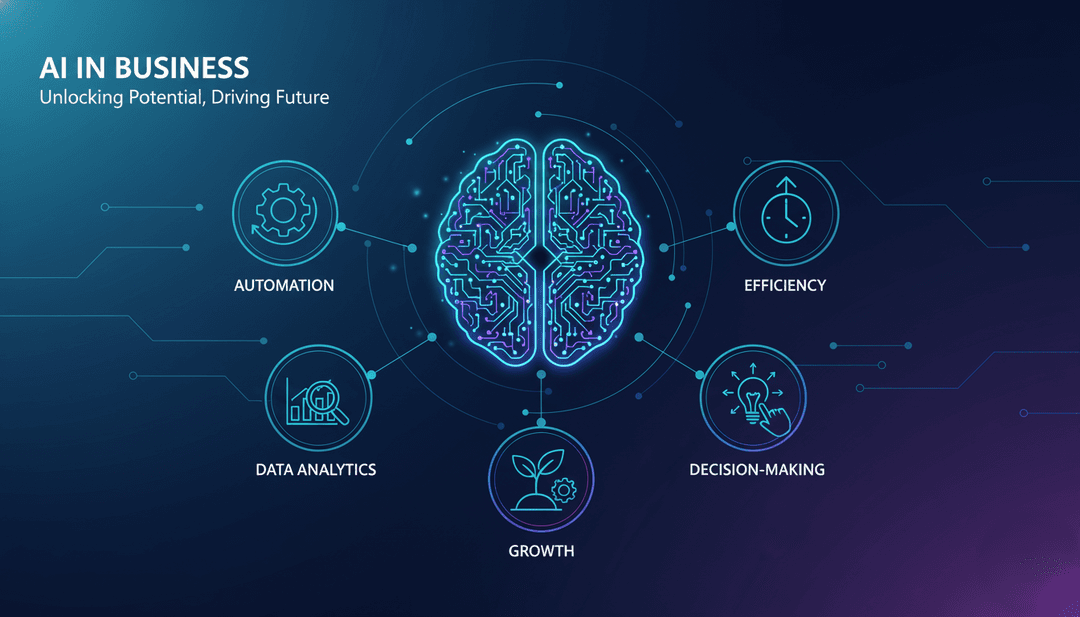
Benefits of Artificial Intelligence (AI) in Business
Have you ever wondered how some companies seem to do things faster, smarter, and smoother than ever before? There's a good chance they're using Artificial Intelligence, or AI.But what is AI? Don't let the technical name scare you. Think of AI as smart technology that can learn from information, recognize patterns, and help with tasks that normally require human thinking. This could be anything from answering customer questions instantly to finding ways to save money.AI isn't just a futuristic idea anymore, it's a real tool that businesses are using right now to get ahead. It's changing how companies, both big and small, operate every single day.But why are so many businesses adding AI to their toolbox? The simple answer is because it offers real, practical benefits.In this blog, we're going to skip the complicated jargon and focus on the good stuff. We'll explore the key ways AI can help your business work better, make your customers happier, and help your team focus on what truly matters. From saving time on everyday tasks to discovering new opportunities for growth, let's dive into the benefits of AI.Defining Artificial Intelligence (AI)Now that we know AI is helpful, let's quickly cover what it actually is. At its heart, Artificial Intelligence is technology that allows computers and machines to simulate human intelligence to perform tasks.This doesn't mean we're talking about walking, talking robots from the movies. For a business, AI is usually software that can "think" and "learn" to handle specific jobs.Think of it this way:You give it data: This information can be anything customer emails, sales numbers from last year, website visitor clicks, or even pictures of your products.It learns from the data: The AI's main job is to process all this information and find patterns. It's incredibly good at spotting connections and trends that a person might easily miss.It takes action or gives an insight: Based on what it learns, the AI can then do something useful. It might automatically sort customer support tickets, predict how many products you'll sell next month, or give you a smart recommendation on how to improve your marketing.So, when we talk about AI in business we're simply talking about using this smart technology to automate tasks, analyze information, and help you make better, faster decisions. It's a tool to support your team and make your company run more efficiently.Why is AI Good? Examples of AI You Can See TodayAI isn't just one single thing. It’s a collection of different technologies that show up in tools you might already be using. What can AI do for business? For a business, AI provides power in many different forms. Here are a few common examples.1. Generative AI ToolsThese are the tools you've likely heard about the most. Generative AI creates new content, like text, images, or sound.How it helps: Instead of starting from a blank page, your team can use Generative AI to draft a blog post, write marketing emails, or create an image for a social media update. It’s like having a creative assistant to help you brainstorm and produce content faster.2. Business Intelligence (BI) PlatformsThink of these as your company's "smart dashboards." Traditional BI tools just show you charts and graphs of your sales. AI-powered BI tools let you ask questions in plain English.How it helps: You can type, "Which product sold best in the northeast last quarter?" and the AI will find the answer for you. It helps you understand what all your business data means without needing to be a data scientist.3. Development Tools (like Automatic Code Generators)For companies that build their own software or websites, AI is changing the game. These tools like icod.ai act as a "smart partner" for programmers.How it helps: As a developer types, the AI suggests the next lines of code, and sometimes whole functions. This helps your tech team build new features faster and with fewer bugs.4. Analytics PlatformsIf BI tools help you understand the past and present, analytics platforms use AI to predict the future.How it helps: This is called "predictive analytics." It can analyze past trends to help you forecast how much inventory you'll need for the holidays or which customers might be at risk of leaving. This lets you make proactive decisions.5. Cybersecurity Augmentation (Making You Safer)It's impossible for a human team to watch every single bit of activity on a company's network 24/7. AI acts as a tireless digital security guard.How it helps: AI learns what your "normal" network activity looks like. When it spots something unusual like a strange login or an email that looks like a phishing attempt it can instantly flag it or even block it, helping to catch threats before they do damage.6. Market Research and Target Audience SegmentationAI is incredibly good at finding patterns in customer behavior.How it helps: Instead of just grouping your customers by simple things like age or location, AI can analyze how they act. It can find groups you never knew existed, like "customers who only buy on sale" or "new visitors who read three blog posts before buying." This lets you create marketing messages that are far more relevant and effective.Benefits of AI in Your BusinessNow that we know what AI is and where it's being used, let's get to the most important part: what can it actually do for you? And why is AI good? Here are the seven biggest benefits of bringing AI into your business.1 – Improved Decision-MakingBusinesses run on decisions, and AI helps you make smarter ones. Every day, your company creates a huge amount of data from sales figures and website clicks to customer feedback. It's impossible for a person to see all the hidden patterns, but AI can.Instead of just guessing or using a "gut feeling," AI-powered dashboards can analyze all that information in real-time. It can show you why something is happening, helping you make data-driven decisions faster and with more confidence.2 – Increased EfficiencyIn every business, there are tasks that are necessary but repetitive and time-consuming. This is where AI shines. It can automate these routine tasks, working 24/7 without getting tired or making errors.3 – Enhanced Customer ExperienceToday's customers expect fast, personal service. AI makes that possible on a large scale.24/7 Support: AI-powered chatbots can answer common customer questions instantly.Personalization: AI can look at a customer's past purchases and browsing history to offer relevant product recommendations.4 – Cost ReductionWhen your operations are more efficient, you save money.By automating tasks, you reduce the hours of manual labor needed.By improving customer service with AI, you can handle more inquiries without dramatically increasing your staff size.By using AI to find errors, you save money on fixing costly mistakes.5 – Risk ManagementAI is like a super-intelligent security guard for your business.Cybersecurity: AI can monitor your network activity and flag suspicious behavior.Financial Fraud: AI can spot patterns that look like fraud and protect your finances.6 – InnovationAI can be a powerful partner for creativity and innovation.Product Development: Analyze customer reviews to discover new feature opportunities.Creativity: Brainstorm ideas faster and break creative blocks.7 – Predictive AnalyticsIf most data tools tell you what happened, AI helps predict what will happen next by analyzing historical data. For example, a retail business can forecast inventory needs and avoid over-ordering or running out of popular items.Ready to move from theory to reality? Let Techtimize AI Services build the specific AI solutions that will grow your business.


