
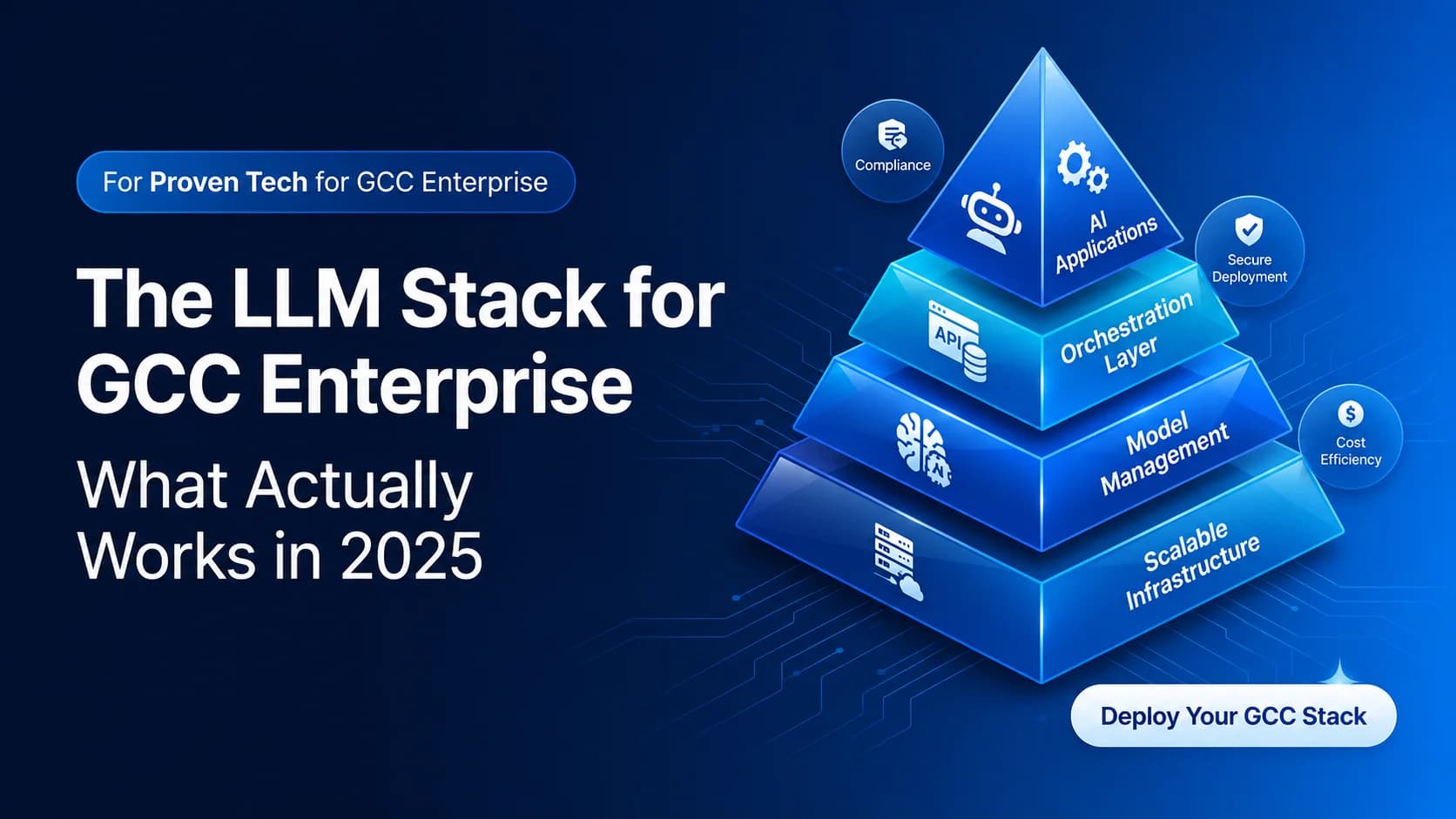
The LLM Stack for GCC Enterprise: What Actually Works in 2025
The Infrastructure Problem
Most enterprise LLM deployments in the GCC fail not because of the model — but because of everything around it. The prompt engineering looks fine. The API integration works in staging. And then the first production spike hits and the whole thing falls apart.
We have audited over 40 enterprise AI projects in the Gulf and the failure modes are remarkably consistent: no caching layer, synchronous LLM calls blocking the main thread, no failover between providers, and data residency violations that legal eventually finds.
The Production-Grade Stack
After building LLM systems that collectively process millions of requests monthly, this is the stack that actually works in GCC enterprise environments.
1. Multi-Provider Gateway
Never point your application directly at a single LLM provider API. Every production system needs an LLM gateway layer that handles provider failover, semantic caching, and model routing. When OpenAI goes down (and it will), your application should automatically route to Anthropic Claude or Gemini without a single customer noticing.
2. Semantic Caching
Semantic caching is the single highest-ROI optimisation in most LLM stacks. By indexing previous LLM responses as embeddings and retrieving cached responses for semantically similar queries, you can achieve 30–60% cache hit rates on support and FAQ use cases — cutting costs and latency in half.
3. RAG Architecture for Accuracy
For enterprise deployments where accuracy is non-negotiable, RAG (Retrieval Augmented Generation) beats fine-tuning in most scenarios. Build your vector store on Pinecone or pgvector, implement hybrid retrieval combining dense embeddings and BM25 sparse search, and add a cross-encoder re-ranking step. The result is a system where the LLM has access to your exact, current enterprise knowledge — not its training data from 18 months ago.
Data Residency: The Non-Negotiable
For GCC enterprises, data residency is not optional. Saudi PDPL and NCA ECC have explicit requirements about where enterprise and citizen data can be processed. The answer is always AWS Bahrain (me-south-1) or on-premise deployment. For the LLM layer, this means either routing sensitive data through self-hosted open-source models (Llama 3, Mistral) on your own infrastructure, or ensuring the LLM provider's DPA covers your regulatory requirements.